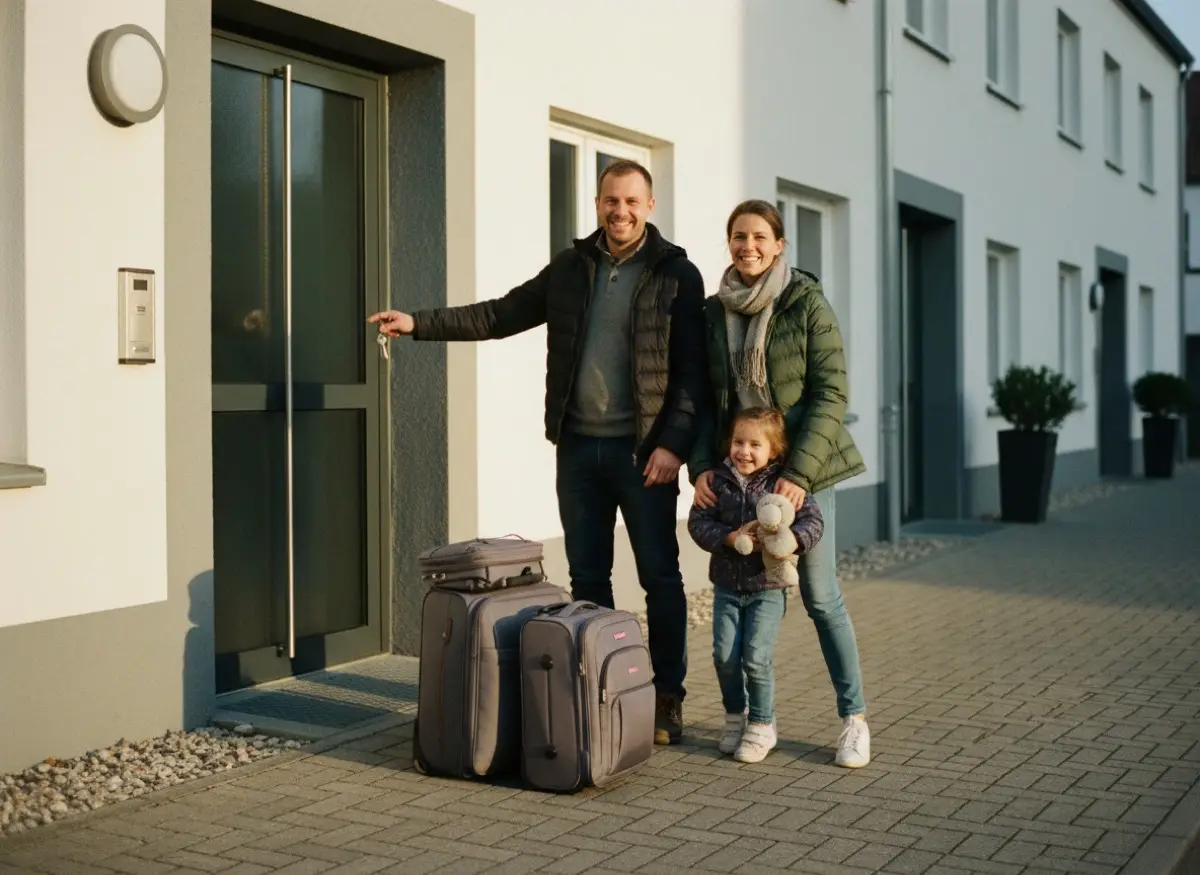
Many applicants ask us: “I have a Romanian passport, my wife only has a Moldovan one. Can we move to Germany together?” The short answer: yes. European law protects the families of EU citizens who work in another EU country. Here we explain how it works and what to do.
This article is general information and not legal advice. The local authorities are responsible, and their practice can differ. As of September 2026.
Who may come along
The legal basis is the EU Freedom of Movement Act (FreizügG/EU) and EU Directive 2004/38/EC. Family members are:
- spouses and registered partners,
- children under 21 – your own children and your spouse’s children,
- older children and parents, if they are supported financially.
Condition: the family member with the EU passport has the right of free movement in Germany, most simply as an employee with an employment contract. In that case there is no minimum income required for the family to join.
Important: this applies to citizens of other EU countries, for example Romania, Bulgaria, Latvia, Lithuania or Poland. If the spouse is a German citizen (for example a late repatriate, Spätaussiedler), different rules apply: a national visa through the embassy and usually proof of German at level A1.
Is German needed?
No. The law does not require German language skills for spouses of EU citizens. This is a big difference from joining a German citizen or a non-EU citizen, where A1 is usually required.
Entry: visa or not?
- Citizens of the Republic of Moldova with a biometric passport and citizens of Ukraine can enter without a visa. Within three months of arrival, you go to the immigration office (Ausländerbehörde) to have your right of residence confirmed.
- If you need a visa, you get a special visa for family members of EU citizens. It is free of charge and processed quickly, usually within two weeks.
- If you already have a residence card as a family member of an EU citizen from another EU country, you do not need a visa.
The authorities’ practice is not the same everywhere: some ask for a visa even when entry without a visa is allowed. So check with the immigration office in your future place of residence beforehand. We will tell you where to go.
Which documents you need
Usually:
- passport of the family member,
- marriage certificate (for children, the birth certificate), usually with an apostille and a German translation,
- passport or ID card of the EU spouse,
- employment contract or employer’s certificate of the EU spouse,
- certificate of address registration (Meldebescheinigung),
- biometric photo.
Tip: get the apostille on the marriage certificate in your home country. This is not possible in Germany, and without an apostille the process can be delayed.
Step by step in Germany
- Address registration (Anmeldung). Within two weeks of moving in, the whole family registers at the citizens’ office (Bürgeramt), with the landlord’s confirmation (Wohnungsgeberbestätigung). More under Moving and registration.
- Applying for the residence card. At the immigration office in your place of residence, the family member applies for the residence card for family members of EU citizens. When you apply, you usually get a certificate straight away.
- Issue. The authority issues the residence card within six months; it is valid for five years. The fee is about the same as for a German ID card; the authority will tell you the exact amount.
The card only confirms the right of residence – this right exists by law if the conditions are met.
Can the spouse work?
Yes. Spouses of EU citizens who work in Germany may work from the start, without a separate work permit. In practice, employers usually ask for the residence card or the application certificate. That is why it is worth applying right after your address registration.
This way both spouses can work with us: for example, he as a forklift driver (m/f/d), she in production or in the warehouse.
Move together or one after the other?
Both are possible. It is often easier if the spouse with the EU passport comes first, starts work, registers the address and has the employment contract. With these documents, it is easier for the family to follow. If no visa is needed, the family can also enter together.
Children and school
Children under 21 are also family members. School is compulsory in Germany: after address registration, the child is enrolled at a school. The city’s school office (Schulamt) can help.
What to avoid
- Sham marriage. The authority can check whether the family really lives together. A marriage just for papers does not give a right of residence.
- Offers of “papers for money”. You do not need middlemen for family reunification with EU citizens: the visa is free of charge, and you make the application yourself. More on warning signs under Who can work in Germany.
How we support families
We help with moving, address registration and the first steps in Germany. Accommodation can be provided on request. If you want to come with your family, tell the recruiter in the interview – we take this into account when choosing the place of work and the accommodation.
Ready? Fill in the application form; it takes about one minute.