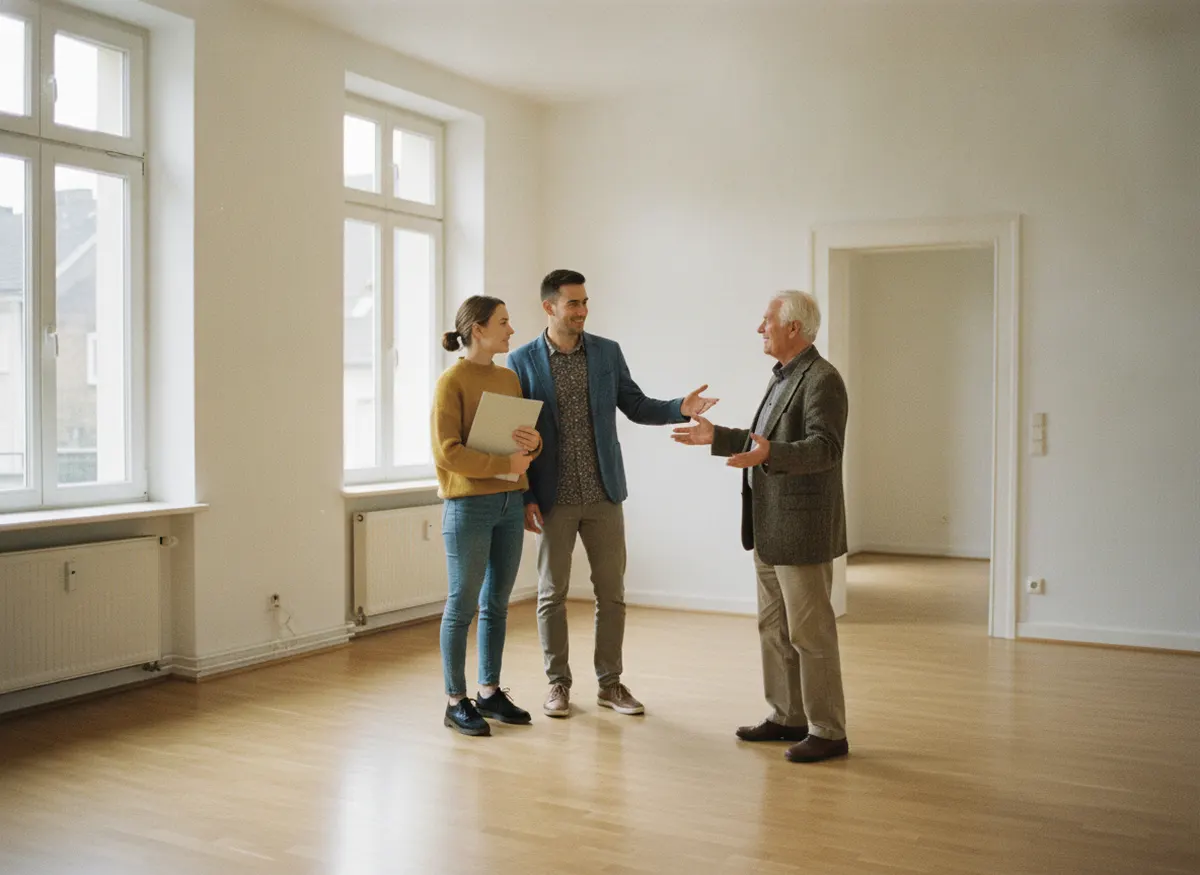
Finding a flat is one of the hardest steps after moving to Germany – especially in larger cities. Many people often come to viewings, and the flat usually goes to the person whose documents are in order. Here you can learn what to prepare and how to protect yourself from fraud.
As of: October 2026. General information, not legal or tax advice.
In short: To rent a flat you usually need ID, proof of income (payslips or an employment contract), a Schufa credit report and a tenant self-disclosure form. The deposit may be at most three months’ net base rent (§ 551 BGB). After you move in, the landlord must give you a landlord confirmation (Wohnungsgeberbestätigung) for your address registration (§ 19 BMG).
Base rent, total rent, service charges
| Term | Meaning |
|---|---|
| Kaltmiete / Nettokaltmiete (base rent) | Rent for the flat itself only |
| Nebenkosten / Betriebskosten (service charges) | Water, waste collection, cleaning of the building, property tax and more |
| Heizkosten (heating costs) | Heating, often also hot water |
| Warmmiete (total rent) | Base rent plus service charges and heating costs |
| Kaution (deposit) | Security for the rent, paid back after you move out |
| Provision (commission) | Estate agent’s fee |
Electricity and internet are usually not included in the total rent – you sign these contracts yourself. You pay service charges in advance every month; once a year you get a statement (Nebenkostenabrechnung) with either an extra payment or a refund.
Document checklist
ID
Passport or ID card for identification. According to the data protection authorities, only identification and contact details may be collected at a viewing; a copy of your ID belongs only to the stage shortly before the contract is signed.
Proof of income
- Payslips – usually the last three months,
- Employment contract – important if you have only just started,
- possibly a confirmation from your employer (Arbeitgeberbescheinigung).
You may black out details that are not needed (e.g. tax class or religion).
Schufa credit report
Schufa shows whether you pay bills and loans reliably. Two documents are often confused:
- Free data copy under Art. 15 GDPR: can be requested at any time, contains all stored data, meant for your own checking.
- Paid BonitätsAuskunft: a shorter version made specifically for giving to landlords and other third parties.
People who are new to Germany often have very few entries. Then your employment contract and income count even more.
Confirmation of no rent debts (Mietschuldenfreiheitsbescheinigung)
A confirmation from your previous landlord that you have no rent debts is often requested. But in 2009 the Federal Court of Justice ruled (VIII ZR 238/08) that landlords do not have to issue it – they only owe a receipt for payments received. Bank statements showing your rent payments are a good alternative.
Tenant self-disclosure (Mieterselbstauskunft)
A form asking for your name, contact details, job, employer, income and the number of people who will live in the flat. Only questions related to the tenancy are allowed (guidance of the German Data Protection Conference). Questions about religion, political party or plans to have children, for example, are usually not allowed and you do not have to answer them.
Tip: an application folder for landlords
Prepare all documents in advance in a folder or as a PDF: ID, employment contract, payslips, Schufa report, self-disclosure form and, if you have one, the confirmation from your previous landlord. A short cover letter with a few sentences about you, your employer and your desired move-in date also helps. This way you can react immediately after a viewing. But only send full copies when the listing and the landlord seem trustworthy.
Deposit under § 551 BGB
- at most three months’ rent without service charges,
- payment in three equal monthly instalments is allowed; the first is due at the start of the tenancy,
- the landlord must keep the deposit separate from their own money,
- agreements that differ from this to the tenant’s disadvantage are invalid.
The deposit is due after signing the contract – never before the viewing.
Viewing
- Arrive on time and bring a folder with your documents.
- Check windows, heating, damp and mould, water pressure and the kitchen.
- Ask about the amount of service charges, the type of heating and whether there is a fitted kitchen.
- Clarify whether the landlord will issue the landlord confirmation (Wohnungsgeberbestätigung).
Landlord confirmation and address registration
After moving in, you must register your address (Anmeldung) within two weeks. For this, the landlord must confirm your move-in in writing or electronically under § 19 of the Federal Registration Act (Bundesmeldegesetz). If they refuse, you must inform the registration office immediately. Offering an address for registration where nobody actually moves in (fake registration, Scheinanmeldung) is forbidden.
More at Moving and registration.
Common scams
Consumer advice centres (Verbraucherzentralen) regularly warn about fake listings. Warning signs:
- rent far below the market price, nice photos but no exact address,
- the landlord is supposedly abroad and wants to send the key by post or through an “agency”,
- payment in advance or a deposit before the viewing and before the contract,
- a copy of your ID is requested right away,
- time pressure: “There are many people interested, decide today.”
Basic rule: No money for a flat you have not seen and for which there is no signed rental contract. You can find more warning signs in How to spot fake job offers.
A room in a shared flat (WG) as a start
In a shared flat (Wohngemeinschaft, WG) you have your own room and share the kitchen and bathroom. For newcomers this is often the easiest start:
- fewer document requirements,
- rooms are often furnished,
- you can keep looking calmly once you have payslips and a German address.
In a WG you also need a landlord confirmation (Wohnungsgeberbestätigung) for your address registration.
Housing entitlement certificate (WBS) in brief
With a WBS (Wohnberechtigungsschein) you may rent subsidised social housing. The city or municipality issues it if your income is below certain limits. Each federal state sets its own conditions and income limits, and free social housing is often scarce. Ask your city.
Accommodation with a job through us
If you work with us, accommodation can be provided if needed – near your workplace. More on the page Accommodation. This is an offer, not an obligation: you can always look for a place yourself. We help with moving and address registration (Anmeldung). Applicants do not pay us a placement fee.
We pay from €15.33 per hour gross, and as a forklift driver (m/f/d) from €16.08 per hour gross. Have a look at the jobs or fill in the application form and tell us whether you need accommodation.