In short: an order picker (m/f/d) puts together goods for orders in the warehouse – using a pick list, a handheld scanner or voice instructions. Often the job also includes packing, goods receipt, goods dispatch and stocktaking. Training is usually not needed; what matters is care, reliability and physical fitness.
What does “kommissionieren” mean?
“Kommissionieren” means taking the right items in the right quantity from stock for an order. The order can be a delivery to a shop, to a factory or to an online customer. In everyday warehouse work, people often just call it “picking” (picken).
This makes the order picker a key link in the logistics chain: if the wrong item or the wrong quantity ends up in the box, the customer will notice. That is why in the warehouse it is not only speed that counts, but above all accuracy.
Typical tasks in the warehouse
Picking with a pick list or scanner
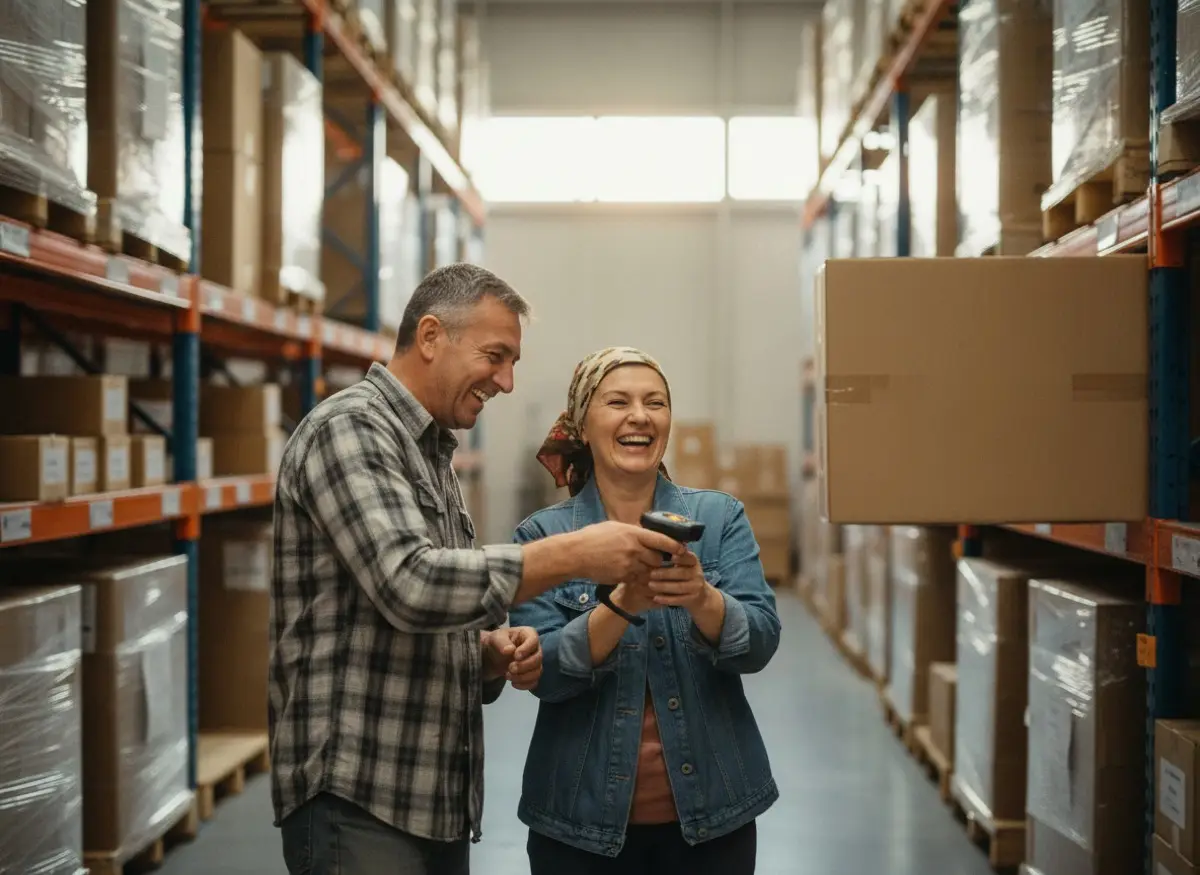
The classic way: you get a pick list (Pickliste) on paper or an order on a handheld scanner (MDE device). It shows the storage location, item number and quantity. You go to the shelf, take the goods, scan the barcode and put them in the container or on the pallet. The scanner tells you straight away if the item is wrong.
Pick-by-voice and pick-by-light
Some warehouses work differently:
- Pick-by-voice: you wear a headset. A computer voice tells you the storage location and quantity, and you confirm by speaking. Your hands stay free.
- Pick-by-light: lamps light up on the shelf compartments to show which compartment to take how many items from. You confirm by pressing a button.
Both systems are simple and are considered easy to learn.
Packing and preparing for shipping
After picking, the goods are packed: choosing a box, filling material, delivery note, label. For pallets, the goods are stacked safely and wrapped in film.
Goods receipt and goods dispatch
Deliveries arrive at goods receipt (Wareneingang). You check them for quantity and damage, enter them into the system and take them to their storage location. At goods dispatch (Warenausgang), the finished goods are made ready for collection and loaded.
Stocktaking
During stocktaking (Inventur), the stock is counted and compared with the computer. This happens regularly, at least once a year.
Important German words in the warehouse
If you know these terms, you will find your way around better from day one. More tips for starting without German: Jobs without German.
| German | Meaning | Russian |
|---|---|---|
| Lager | place where goods are stored | склад |
| Kommissionieren / picken | putting together goods for an order | комплектовать заказ |
| Pickliste | list of items to collect | лист комплектации |
| Handscanner | device for scanning barcodes | ручной сканер |
| Lagerplatz | exact spot on the shelf | место хранения |
| Artikelnummer | product number | артикул |
| Palette | wooden platform for goods | поддон, паллета |
| Hubwagen | hand-operated pallet truck | ручная тележка (рохля) |
| Gabelstapler | motorised lifting vehicle (forklift) | погрузчик |
| Wareneingang | receiving deliveries | приёмка товара |
| Warenausgang | getting goods ready for shipping | отгрузка |
| Inventur | counting stock | инвентаризация |
| Sicherheitsschuhe | work shoes with a protective toe cap | защитная обувь |
| Warnweste | high-visibility vest | светоотражающий жилет |
| Vorsicht! | careful, danger | Осторожно! |
What should you bring with you?
- Physical fitness: you are on your feet a lot, lift and carry boxes and sometimes work in cool halls.
- Care: the right items, the right quantity – that is the most important rule.
- Reliability and punctuality: in a warehouse, many processes depend on each other.
- Right to work: an EU passport or a German residence permit that allows you to work. Details: Who can work in Germany?
Safety shoes and protective clothing
In almost every warehouse, safety shoes are compulsory, and often also a high-visibility vest and gloves. Under the Occupational Safety and Health Act (§ 3 (3) ArbSchG), the employer generally may not make employees pay the costs of required safety measures. We will discuss with you before you start how protective equipment is handed out at your specific workplace.
As of October 2026. General information, not legal or tax advice.
Warehouse worker, forklift driver, production helper – what is the difference?
| Job | Typical tasks | Requirement |
|---|---|---|
| Warehouse worker (m/f/d) / order picker | picking, packing, goods receipt, stocktaking | no training needed |
| Forklift driver (m/f/d) | moving pallets with a forklift, putting goods into and taking them out of storage, loading lorries | forklift licence and written authorisation from the employer |
| Production helper (m/f/d) | loading machines, assembling, checking and packing in production | no training needed |
Many people start as warehouse workers. If you already have a forklift licence, you can apply directly as a forklift driver – more in the article about the forklift licence in Germany.
How much do you earn?
With us there is a simple rule: from €15.33 per hour gross for warehouse workers and production helpers (m/f/d), from €16.08 per hour gross for forklift drivers (m/f/d). How much is left net depends on your tax class and personal situation – explained in the article Gross and net.
On top of that, you get an employment contract, full social insurance, paid holidays and sick pay. Our placement is free of charge for applicants.
Where we are looking for order pickers
Our biggest need at the moment is in Diemelstadt (Hesse, Waldeck-Frankenberg district) – near Warburg, Marsberg and Bad Arolsen. We are currently looking for 30 warehouse workers (m/f/d) there. More about the location: Work in Diemelstadt.
Other locations are Paderborn, Göttingen and Hannover. You can find all open positions under current jobs.
If you come from another city or from abroad, we help with moving and address registration (Anmeldung). Accommodation can be provided if needed.
Apply now as an order picker
Do you want to work in a warehouse? Fill in our application form – it takes about one minute. We will get back to you, discuss the right location with you and answer your questions, in German, English or Russian.